

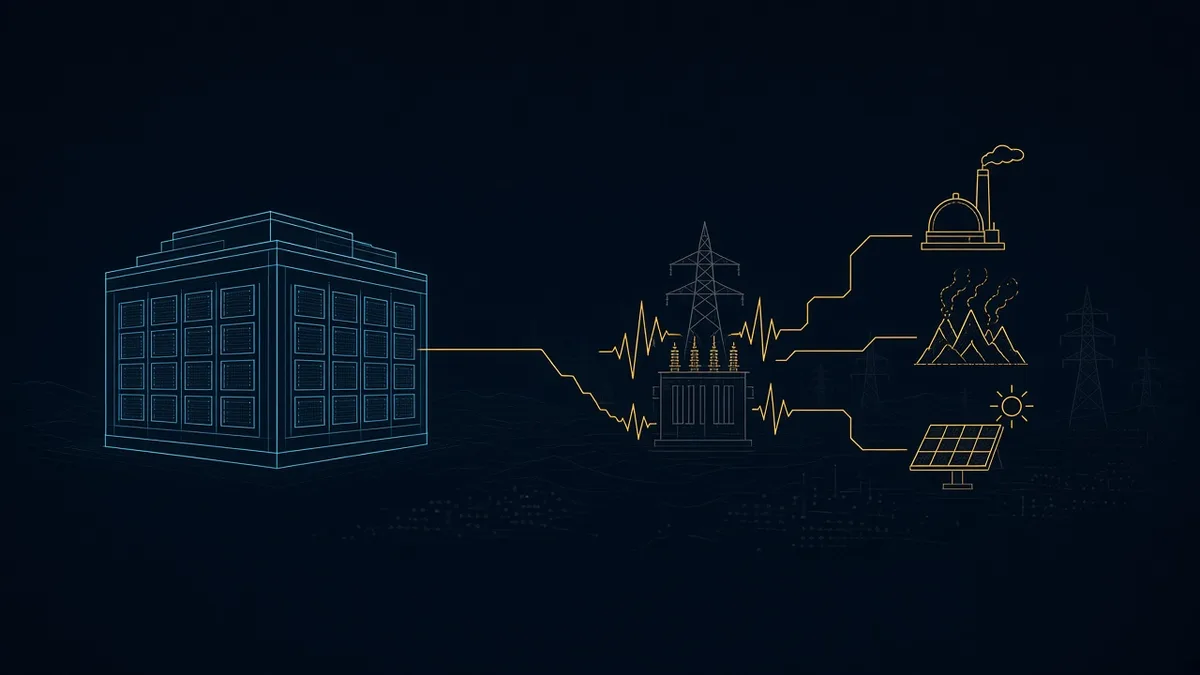
The bottleneck left the GPU brochure and entered the utility docket. If the substation cannot feed the cluster, the model does not train, no matter how good the paper was.
Understanding the constraint
Frontier clusters are industrial loads. Training runs want steady megawatts. Inference at product scale wants them all day. Cooling wants water or a large power budget for dry systems. Municipal utilities were planned around homes, hospitals, and ordinary industry, not around a campus that appears in a single procurement cycle.
The political response is predictable and already visible: regulatory headwinds, slower permits, and organized opposition when people connect a new hall to a rate hike or a water restriction. Energy providers and labs are answering with contracts that pull generation out of the shared peak — restarts or offtake from nuclear, geothermal where the geology allows it, and solar paired with storage or with a firm backup. “Off-grid” in these announcements often means dedicated, not literally an island with no wires. Read the contract.
None of this is a reason to invent a megawatt figure for a specific campus here. The pattern is the point: power is now a critical-path dependency with a public counterparty.
The engineering framework
If you buy capacity rather than build a campus, you still inherit the constraint.
Region choice is a latency and a politics choice. A cheap region with a hostile permit climate is not cheap if your reservation slips a year. California’s grid politics and Florida’s storm and growth profile are different risks; both are real for teams placing workloads that serve those states.
Your product’s energy is mostly inference once it ships. A clever training run is a one-time spike. A chatbot or call agent that runs all day is the bill. Routing closed decisions to a small model, as in the decoupled agent stack, is an energy decision as much as a latency decision.
Contracts need an owner. Who is on the hook if the dedicated plant slips? If you are a software buyer, that owner is your cloud region’s status page, not a reactor. Design a second region before you need it.
I do not site power plants. I do design agents so they do not call a frontier model for every turn. For California and Florida operators, that is usually the lever you actually control: workflow automation that spends tokens only when the step needs them.
Count energy where you can still change it
Most software teams will never sign a nuclear offtake. They will sign a cloud bill. The useful accounting is energy-shaped even when the invoice is in dollars: tokens per successful task, region, and model class. Split the bill into closed decisions and open prose. If a router that could have been a typed classifier is a frontier call, you are renting a data-center problem you do not need.
Put a daily cap on agent loops. An uncapped computer-use agent that retries screenshots overnight is a small campus of its own. Alert on cap breaches the way you alert on error budgets.
When you do choose a region for California or Florida users, read the provider’s capacity notices, not only the latency map. A region that is close and power-constrained will queue you at the worst time. A second region is part of the design, tested, not a slide. Dedicated generation at hyperscale is the labs’ problem. Not calling them for every click is yours.
The fight is local even when the model is not
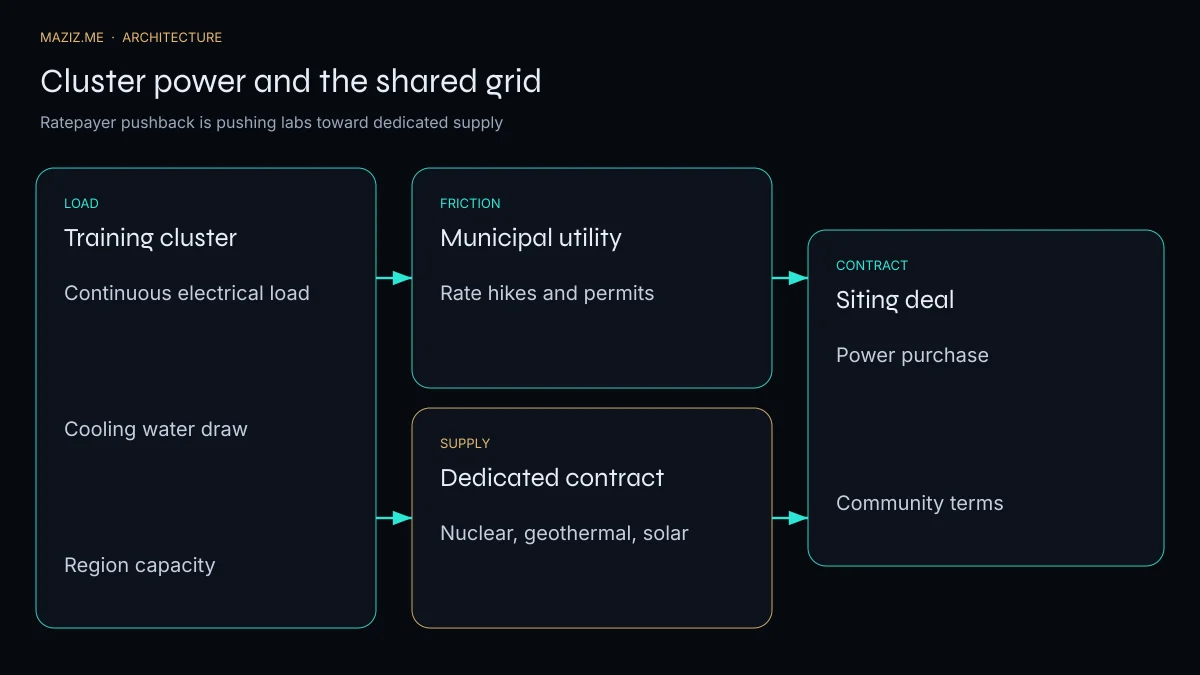
A training cluster is a continuous electrical load with a cooling-water draw. Municipal utilities were not built for a single customer to arrive and ask for a new town’s worth of power on a data-center campus. The friction shows up as permits, interconnection queues, water hearings, and rate cases. Residents hear “ratepayer” and mean the bill on their kitchen table. That is the political fact. Labs and hyperscalers can be correct about demand and still lose the room.
The response you can read in the deals, not just the keynotes, is dedicated supply: nuclear, geothermal, and solar offtake arranged for the campus rather than taken entirely from the shared peak. “Off-grid” is the loose phrase. Often it means a dedicated contract and a dedicated interconnect, not a literal island with no utility at all. Do not repeat a megawatt figure you did not read in the filing. The shape of the deal matters more than a number that will be stale by the time you cite it.
This is not a software abstraction. It is why a region that looks close on a latency map can still be a bad place to put a workload. Capacity notices are part of architecture now.
What a software team can still change
Most of us will never sign a generation contract. We will sign a cloud bill. The useful accounting is still energy-shaped: tokens per successful task, region, and model class. Split the bill into closed decisions and open prose. If a router that could have been a typed classifier is a frontier call, you are renting a data-center problem you do not need. That is the practical link to decoupled computer-use agents. Every full-screen screenshot you send is someone else’s substation, in miniature, on your invoice.
Put a daily cap on agent loops. An uncapped computer-use agent that retries screenshots overnight is a small campus of its own. Alert on the cap the way you alert on an error budget. When you choose a region for California or Florida users, read the provider’s capacity notices, not only the latency map. A nearby region that is power-constrained will queue you at the worst hour. A tested second region is part of the design. Dedicated generation at hyperscale is the labs’ problem. Not calling them for every click is yours.
I treat this as a design constraint in workflow automation: the loop should stop when the check passes, not when the budget is exhausted by accident. A harness without a cap is a load you did not mean to build.
How to talk about it without inventing a plant
If you write or brief this topic, separate three layers. The municipal layer is water, rates, and permits. The contract layer is dedicated nuclear, geothermal, or solar supply and the community terms attached to the site. The product layer is your token budget, your region pair, and your refusal to use a frontier model as a thermostat. Mixing the layers is how blog posts end up claiming a campus has “left the grid” because a press release used the words.
For operators in California and Florida, the local version is simpler. Your customers feel rate pressure and heat seasons directly. A product that burns frontier calls to do routing will be hard to defend the week the utility story is on the front page, even if your servers are in another state. Efficiency is the part of the story you actually control. Say what you measured — tasks, retries, region — and leave the unnamed megawatts in the filing where they belong.
Key attributes and checklist
- Ask your provider which region is power-constrained, not only which region is cheap.
- Separate training reservations from inference autoscaling. They fail differently.
- Put a token and a request budget on every agent. Unbounded loops are an energy bug.
- Prefer a small decision model for closed actions. Keep the large model for prose.
- Test failover to a second region before the first region posts an incident.
- If you are the one building a campus, publish water and rate impact in the permit, not after the protest.
- Do not market “green AI” from a dedicated solar PPA that covers a fraction of the load. State the fraction.
A one-page energy note for a product review
You can brief this without a utility commission docket. One page is enough.
Name the regions you actually call. Name the model classes: typed decision, retrieval, prose, agent loop. For each, write the cap, the retry rule, and the last week’s count of successful tasks versus calls. If you do not know the count, the note’s first action is to log it, not to estimate a campus. Estimates of other people’s power plants have a way of being quoted later as if you measured them.
Then write the local consequence in a sentence a customer would recognize. A California team running agents through a heat-season capacity crunch should know which region fails over. A Florida team should know the same for storm season and for the hour the shared grid is tight. Your failover test is the sentence. If you have not failed over, do not write that you can.
Close the page with what you refused to call a frontier model for. Routing, classification, and extraction that a smaller or typed model already does are the refusals that cut load. They are also the refusals you can defend in a sales conversation when the data-center story is in the news. You are not claiming you built a reactor. You are claiming you stopped using a reactor to decide which queue a caller belongs in.
That claim is checkable. The reactor stories often are not, unless you are reading the filing. Keep the product note checkable.
Frequently asked questions
Why are communities pushing back on AI data centers?
Large clusters draw electricity and cooling water that local grids and aquifers were not planned to supply. Residents object when that shows up as higher rates, new transmission, or drought risk.
What is an off-grid or dedicated power deal?
A contract where the lab or the campus buys generation — nuclear, geothermal, solar, or a mix — that is reserved for the cluster instead of taken from the shared utility peak.
Does dedicated power make a cluster sustainable?
It can move the burden off the local ratepayer. It does not, by itself, shrink the energy the model uses. Efficiency and siting still matter.
Software teams serving Florida or California still feel this as region choice and as cost per successful call. If you want that cost designed down before you scale the agent, start with the traffic shape.