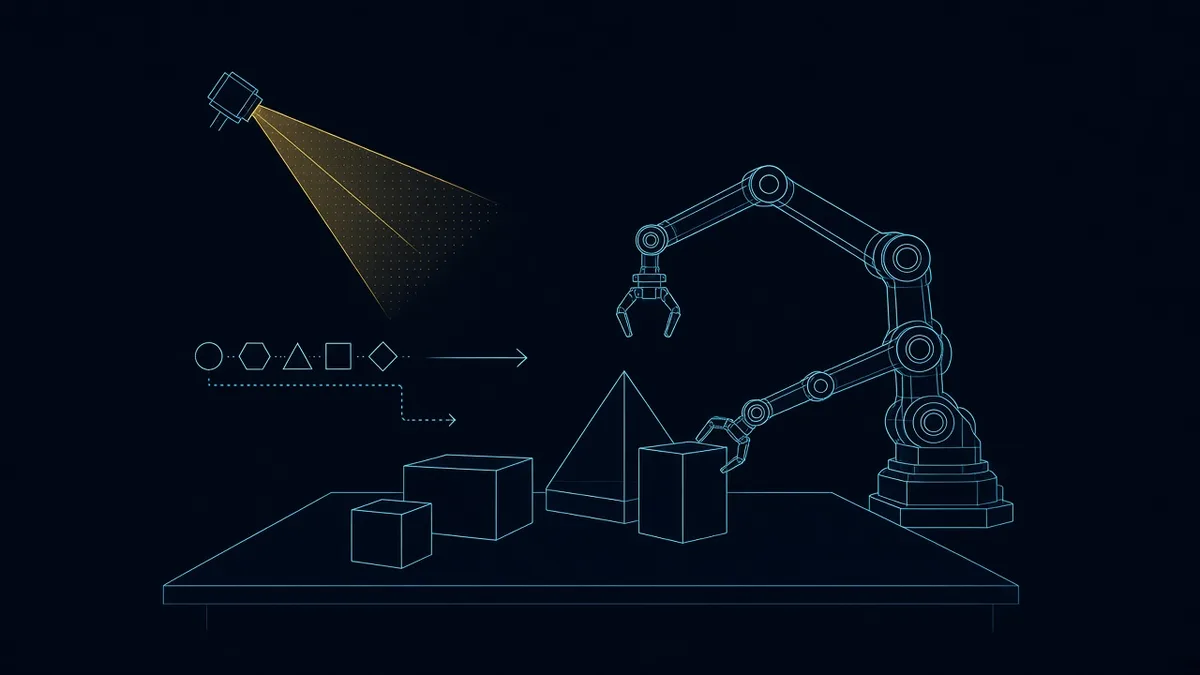
One policy should see, understand the instruction, and move. Bolting a chat model onto a classical controller and calling it embodied is how demos stay demos.
Understanding VLA
Classical robot learning trained a separate policy per task: this grasp, this insertion, this bin. Each policy wanted a fixed camera, a fixed fixture, and a pile of on-robot demonstrations. Change the part geometry and you collected data again.
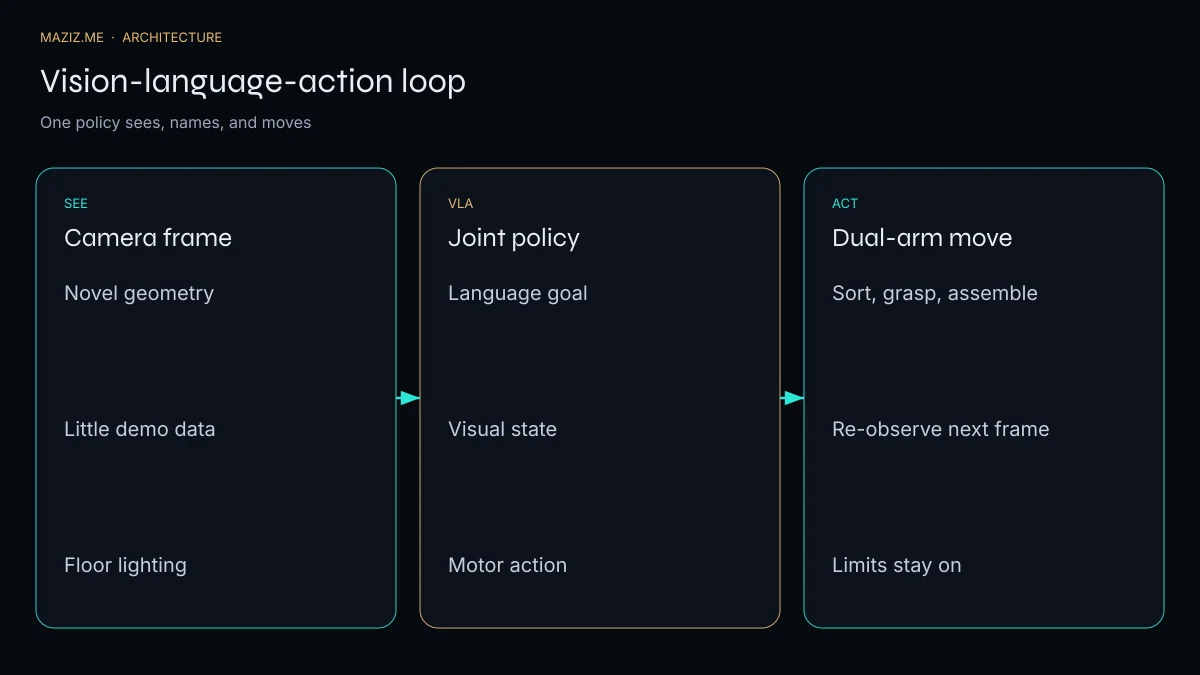
Vision-language-action models collapse the interface. The input is pixels plus a sentence (“sort the metal brackets into the left bin”). The output is an action chunk for the arms. The same weights have seen enough variation that a new shape is a generalization problem, not a new project. In dual-arm work, sorting, and assembly where parts move, that is the reported shift: zero-shot or few-shot visual policies beating a library of narrow RL skills.
“Zero-shot” here means few or no new demonstrations of that exact part on that robot. It does not mean the policy has never seen brackets, bins, or two arms. Read the training mixture before you believe the adjective.
The engineering framework
Keep the foundation model and the cell controller in different trust zones.
Perception is not a screenshot service. The VLA consumes the camera. Do not also ask a separate multimodal chat model to narrate every frame unless you are debugging. Narration adds latency and a second opinion nobody arbitrates. The latency lesson is the same one as a fast decision model versus a writer: if the output is a motor command, do not route it through prose.
Action is chunked and bounded. Predict a short horizon, execute inside force and workspace limits, then re-observe. An open-loop minute of motion is how a generalization error becomes a crash.
Language is the goal, not the servo. “Left bin” must map to a calibrated place. If the sentence is ambiguous, the policy should stop. Ambiguous language is an abstain, the same as a low confidence score.
Demos are a scalpel. Collect a handful of on-hardware trajectories for the residual you cannot get from the foundation model: your gripper, your lighting, your part tolerance. Do not collect a thousand to rediscover “pick up a box.”
Most of my shipping work is software agents, not robot cells. The transferable piece for California automation shops and Florida packaging lines is the contract: a typed action, a confidence or force limit, and a human stop. When the “robot” is a voice or browser agent rather than an arm, that contract is what I implement in RAG and tool-using agents.
How to evaluate a VLA policy on your parts
Do not accept a vendor video as an eval. Film is not a held-out set. Build a tray of your parts that the policy’s demo never used: one shape inside the training distribution, one shape near it, one shape that should be refused. Run a fixed instruction list. Count successes, drops, collisions, and human interventions. Repeat across lighting you actually have on the floor, not studio light.
Report interventions per hundred cycles. That number is what a plant manager can compare to a fixture and a PLC. A policy that is “zero-shot” and needs a person every five cycles is a teleoperation product with extra steps.
Keep the controller’s limits on during the eval. If the only way the demo looks good is with limits off, you measured a different system than the one you will install. Write the limit values next to the score so the next person does not “tune” them away.
Why a narrow policy stalls on a new bin
A task-specific reinforcement learning policy is a specialist. It can be excellent on the geometry it was trained on, and it can be lost when the part is a few centimeters longer or the bin is a different color. The VLA claim is that a model which sees, takes a language goal, and emits an action can treat that new geometry as a variation instead of a new project. Dual-arm sorting, pick-and-place, and dynamic assembly are where that claim is being tested, because those jobs are full of “almost the same part.”
Zero-shot, in this conversation, means the policy was not shown this exact object on this exact robot before the trial. It does not mean the robot is safe, certified, or ready for an unattended line. It means you are measuring generalization, and you should measure it on purpose. A vendor video of a familiar object is not that measurement.
The data claim is the other half. These policies are being asked to adapt with little on-hardware demonstration, because collecting demonstrations on the real arm is slow and the hardware is busy making product. Little is not none. You still need a way to say “that grasp was wrong” without retraining the world model from scratch. Teleoperation and a small correction set remain part of the system. They are no longer the entire system.
A floor test that is not a film
Build a tray of your parts that the demo never used. One shape inside the distribution you expect. One shape near it. One shape the policy should refuse. Write a fixed instruction list in the words your operators use. Run it. Count successes, drops, collisions, and human interventions. Repeat under the lighting you actually have, not studio light.
Report interventions per hundred cycles. A plant manager can compare that number to a fixture and a PLC. A policy that is called zero-shot and needs a person every five cycles is a teleoperation product with extra steps. Write that down without embarrassment. It is a useful result. It tells you the model is a copilot for the arm, not a replacement for the cell.
Keep the controller limits on during the eval. Speed caps, force caps, and a workspace box are part of the system you will install. If the demo only looks good with the limits off, you measured a different robot. Put the limit values next to the score so the next person does not “tune” them away to chase a better clip.
What still belongs to the classical stack
Vision does not repeal fixtures, interlocks, or a stop circuit. A foundation policy can propose a grasp. The robot controller decides whether that grasp is inside the envelope you already engineered. Language can name the part. It should not be the only thing standing between the arm and a person.
Where I connect this to software work is the decision boundary, which is the same idea as a non-text decision model. The policy emits an action from a legal set. It does not narrate a plan and hope someone parses it into joint targets. If you need a written explanation for a quality record, that explanation is a separate step, after the motion, from logs — not a paragraph generated in the control loop.
For a team that builds the software around the cell rather than the arm itself, the durable work is the eval harness, the limit file, and the log. Those travel. The checkpoint will change. I would not bet a line on a checkpoint I cannot re-score on the tray.
Key attributes and checklist
- Write the language goals you will actually speak. Reject the rest.
- Calibrate camera extrinsics before you blame the policy.
- Set force, speed, and workspace limits in the controller, not in the prompt.
- Evaluate on held-out part geometries, not on the demo objects.
- Log image, instruction, action chunk, and outcome. Robotics without traces is folklore.
- Measure interventions per hour. That is the business metric.
- Keep an e-stop that does not depend on the model process.
What to write down next to the checkpoint
A checkpoint without a card is a video. The card I want beside a VLA policy is short. Robot model and controller limits. Camera placement. Instruction list. The tray: which parts were held out. Interventions per hundred cycles. Drops. Collisions. The cases it refused. The date. The person who ran it.
If a new checkpoint arrives, the card is filled again before the old one is retired. You are allowed to prefer the new one. You are not allowed to prefer it because the clip is smoother. Smoother under studio light, with limits relaxed, on a part from the training set, is a different experiment. Say which experiment you ran.
Language in the instruction list should be the language of the floor, including the short names operators already use. A policy that only follows a lab’s phrasing will look broken the morning someone says “the blue housing” instead of the canonical noun. That is a generalization failure you can test without new hardware. Swap the wording. Keep the part. Count what changes.
None of this replaces a safety case. It is the evidence a safety case will ask for, and it is the evidence a buyer in a plant can read without learning the training recipe. If you are the software team beside the robotics team, own the card and the harness that fills it. The weights can come from anywhere. The card is how you refuse to be surprised.
Frequently asked questions
What is a vision-language-action model?
A VLA model takes visual input and a language instruction and outputs robot actions. Seeing, naming the goal, and moving are one policy instead of three systems glued together.
Why are VLA policies replacing task-specific RL?
A narrow RL policy overfits one fixture and one object set. A VLA policy trained across many scenes can attempt a new shape with few, sometimes zero, extra demonstrations on that robot.
Are VLA models safe to put on a factory floor?
Not by default. You still need workspace limits, force limits, e-stops, and an eval on your parts. Zero-shot is a starting point, not a certification.
If the manipulation is digital — a browser, a phone tree, a back-office tool — the same loop still applies, without the arm. California and Florida service pages describe the remote software version of that work.