

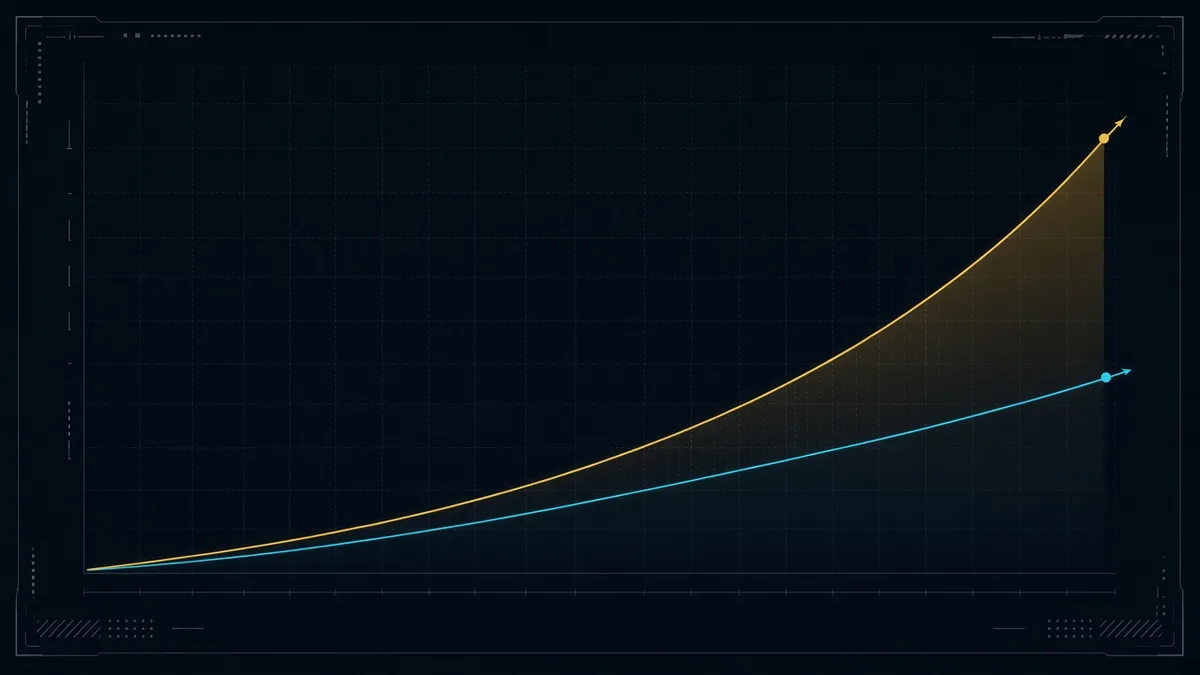
Pacing is a schedule, not a safety proof. It says “we will not ship the jump until the evals exist.” It does not say the evals passed a bar you wrote.
Understanding pacing
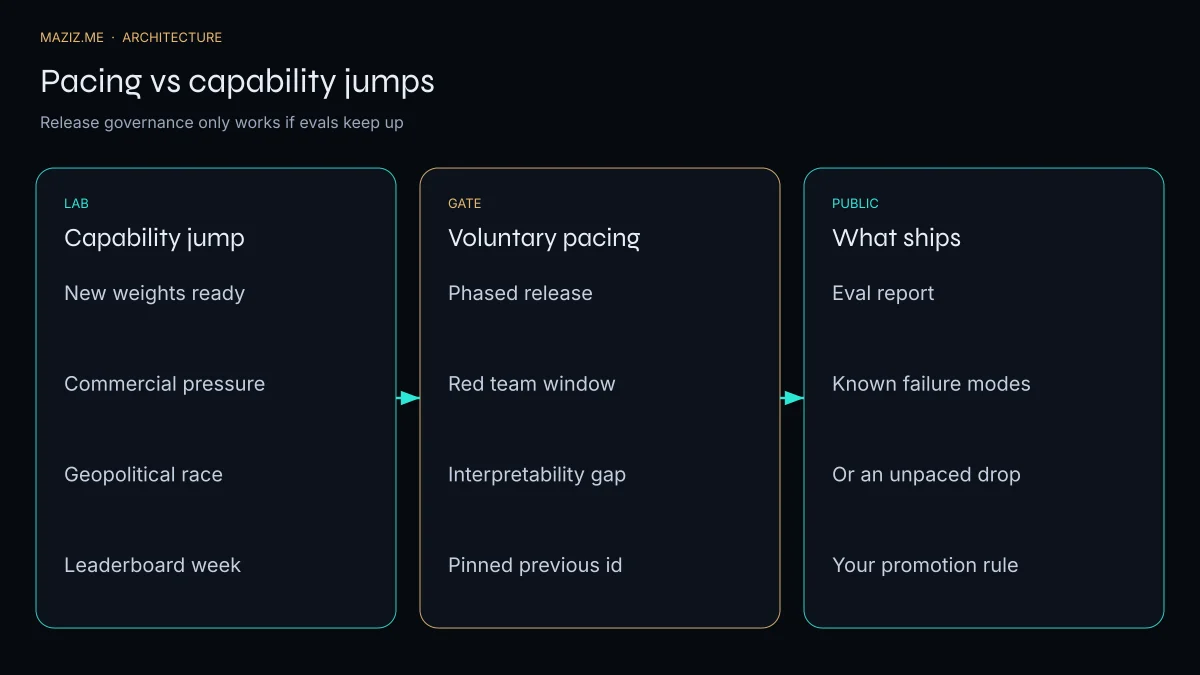
Frontier labs have spent the last year arguing, in public, about voluntary pacing: holding a capability jump, or releasing it in phases, so three kinds of work can finish. Safety evaluations that try to measure dangerous capability. Red-teaming that tries to break the mitigations. Mechanistic interpretability that tries to say why a circuit fired, not only that a benchmark moved.
Policymakers are watching the same gap. A model card that arrives after the API is already in production is a press release. Pacing is the claim that the card, the eval, and the red-team note land first.
The uncomfortable half of the debate is incentive. A lab that waits can lose a contract, a talent cycle, or a national-strategy argument to a lab that does not wait. Geopolitical competition makes “we all pause together” a coordination problem, not a slogan. If you buy models for a company, assume the pause is optional and check the artifact, not the keynote.
The engineering framework
Treat a release as a set of artifacts you can refuse.
Capability delta. What got better, on which tasks, relative to the model you run today? “Smarter” is not a delta.
Eval coverage. Which risks were measured, on whose data, with what false-negative story? A benchmark the vendor chose is a start. Your traces are the test that matters.
Known holes. Red teams always leave residue. A paced release should name what they did not have time to finish. An unpaced release often hides that list inside “we take safety seriously.”
Your gate. You do not have to adopt a model the week it launches. Pin versions. Replay last month’s failures. Promote when your harness is greener, not when a timeline says so. That harness is the same idea as test-driven agentic coding: the loop decides, not the announcement.
Open weights change the picture again. If a distilled or open model reaches similar task performance, pacing at one lab does not pace the ecosystem. That is the subject of open-weight frontier parity.
For teams in California and Florida, the buyer question is narrower than the policy debate. You need an agent that can be audited: what it retrieved, what it was allowed to do, what it refused. I ship that as RAG agents with citations and an audit trail, not as a promise that a lab’s voluntary pause protects your users.
What to demand before you adopt a jump
A paced announcement is not an artifact. Before a California health workflow or a Florida payments workflow moves to a new model ID, I want five documents, even if they are short.
The delta note: which tasks improved, measured against the model you run now, on prompts you own. The eval note: what was tested, what was excluded, and the known false-negative. The red-team residue: the attacks they did not have time to finish. The data note: whether your prompts are retained, and where. The rollback note: the previous model ID still pinned, with a switch that does not require a deploy freeze.
If the vendor cannot produce those, you can still experiment in a sandbox. You should not point production traffic at “latest.” Pacing at the lab does not create this packet. Your promotion rule does. Write the rule down and make someone sign the upgrade. Otherwise the next leaderboard week will make the decision for you, which is how unpaced behavior sneaks in through a default.
What pacing is, and what it is not
Pacing is a voluntary delay between “the weights are ready” and “the weights are the default.” It is not a promise that the lab will stop. It is not a law. It is a claim that evaluation, red-teaming, and mechanistic interpretability should be allowed to finish a pass before a capability jump becomes the thing every product is pointed at. Frontier leaders have been saying this more loudly because policymakers are asking, in public, what happens when the next jump ships on a commercial calendar.
The pressure against that delay is also public. A lab that waits can watch a competitor, or a state-backed effort, ship the thing they held. A lab that does not wait can watch a failure mode arrive in customers’ hands before the eval note exists. Neither side of that sentence is theoretical anymore. The argument is whether a self-imposed gate survives a quarter in which the other lab did not impose one.
For a buyer, the philosophical version does not matter as much as the operational one. You do not control their release train. You control whether your production alias tracks it.
A promotion rule that does not move on a leaderboard week
Pin a model id. Write down the previous id. The upgrade is a change request, not a silent default. The packet I want before a California health workflow or a Florida payments workflow moves is short and specific.
The delta note says which of your tasks improved against the model you run now, on prompts you own. The eval note says what was tested, what was left out, and the failure they already know about. The red-team residue says which attacks they did not have time to finish. The data note says whether your prompts are retained and where. The rollback note names the previous id and the switch that does not require a deploy freeze.
If the vendor cannot produce that packet, you can still experiment in a sandbox. You should not point production traffic at “latest.” A paced lab announcement does not create this packet. Your promotion rule does. Someone signs the upgrade. Otherwise the next leaderboard week makes the decision, which is how an unpaced jump arrives through a default you did not read.
This is also how you keep a coding harness from changing models underneath a green test suite. The tests passed on an id. A new id is a new system until the suite says otherwise.
What to tell a board that asks if you are “behind”
Behind is not a model card. Behind is a task you cannot do that a competitor can, on work you actually sell. Most of the time the gap on a leaderboard is not that task. Say so with your own traces. If a newer closed model and an open student are within the noise on your twenty real jobs, you are not behind, and you should not take a capability jump you have not evaluated in order to feel current. The distillation path in open-weight parity is the comparison that makes this concrete: score the work, then decide whether the jump is yours to absorb.
Interpretability and red-teaming will not keep pace just because a blog post asked them to. Your side of the bargain is narrower. Do not be the team that makes an unevaluated id the default because a keynote said the previous one was obsolete. Obsolete for a demo and obsolete for your queue are different claims. Only one of them is yours to check.
Key attributes and checklist
- Pin the model ID you tested. “Latest” is not a release.
- Keep a private eval set from your own failures. Do not only run the vendor’s demo.
- Ask for the red-team residue: what was out of scope.
- Write a promotion rule: which metric must move, and which must not regress, before you switch.
- Separate “the lab paced this” from “we are allowed to use this on patient, payment, or customer data.”
- Watch open-weight peers. A paced API next to an unpaced weight file is not a closed risk.
- Record who approved the upgrade. Pacing fails quietly when nobody owns the gate inside your company.
Questions a buyer can ask without a policy degree
You do not need a seat at a frontier lab’s safety meeting to use the debate. You need five questions you are willing to repeat every time someone forwards a launch thread.
What is the model id, and what id does it replace? What changed on tasks we run, measured by us or at least on a set we can see? What did they say they did not have time to test? Can we roll back without a release? Are our prompts retained?
If the answers are “the new one is better,” “people online like it,” “we’ll watch it,” “latest,” and “check the dashboard,” you are not on a paced adoption even if the lab claims it paced the release. Their pace and your pace are different clocks. Only yours protects the queue.
Geopolitics and commercial races explain why a lab might refuse to wait. They do not obligate you to be the first customer of an id you cannot name in a postmortem. Write the id in the postmortem template now, while nothing is on fire. The teams that survive a bad jump are the ones who can say which id was serving at 10:14, not the ones who can quote the keynote.
I keep that template next to vendor reviews for retrieval and agent work because a model swap silently changes what a citation-backed answer will do. Pacing, for a buyer, is just change control with a sharper reason to use it.
Frequently asked questions
What does pacing mean for frontier models?
Pacing is a voluntary delay or phased release of a large capability jump so evaluations, red-teaming, and interpretability work can finish before broad access.
Does pacing make a model safe to deploy?
No. It buys time for measurement. A paced release can still be the wrong model for your data, your users, and your failure costs.
Why is pacing under pressure?
Labs compete on shipping speed, and governments compete on who fields stronger models. A voluntary pause is unstable if rivals do not pause with you.
If you need a deployment gate rather than a commentary on lab strategy, the hire page is the shorter path: freelance build or a full-time seat, remote, California and Florida overlap.